
You’ve been good at your job for years, and now your applications vanish. It isn’t you. The jobs go to people the company already knows, and the old way of looking, apply and wait, stopped working years ago. A long search costs far more than money. And the hardest part of fixing it isn’t the resume. It’s asking for help. This is the whole picture: what’s really going on, what it costs you, why people get stuck, and how experienced people get hired.
You’ve been good at your job for years. Now you’re applying and hearing nothing back. Like most people in senior roles, I’ve been out of work more than once. I’ve also spent twenty years on the other side of the table, doing the hiring. So I can tell you now, it isn’t you. It’s the way you’ve been told to look for work.
This article walks through all of it, in the order it usually happens.
Sound familiar?
These are the things I hear on almost every call, word for word. Each one is true, and each one has a number behind it.
“I applied for 100 jobs and got 2 responses.”
You’re one of a crowd. Greenhouse, which runs hiring software for thousands of companies, counted 244 applications per job in 2025, up from 116 in 2022. Ashby, another hiring platform, looked at more than 100 million applications and found it now takes close to 300 of them to make one hire.
At the same time, the number of people reading them went down. Greenhouse’s data shows the average recruiting team shrank from about ten recruiters to fewer than five. Twice the applications, half the people.
“I don’t think a person is even reading it.”
Often, at first, nobody is. In a survey of 384 recruiters by Jobscan, 99.7% said they filter candidates in their applicant tracking system, most often by skills and job title. And it shuts out good people: Harvard Business School and Accenture found 88% of employers agree their systems screen out qualified candidates who don’t match the exact wording of the job description.
When a person does look, it’s quick. The Ladders eye-tracking study, still cited across the industry, found recruiters spend about 7.4 seconds on a first pass of a resume.
“I did the interviews, and they just disappeared.”
You’re not imagining it. Criteria’s Candidate Experience Report found 53% of job seekers were ghosted by an employer in the past year, a three-year high.
“Half these jobs aren’t even real.”
Not half, but more than you’d think. Greenhouse found about 1 in 5 job posts had no active hiring behind them. And in 2025, about 3 in 10 jobs on Greenhouse closed without anyone being hired at all.
“I’m starting to think it’s my age.”
Sometimes it plays a part, and pretending it doesn’t helps nobody. In Australia, only 56% of HR professionals said they were open to hiring people aged 50 to 64 “to a large extent”, according to AHRI and the Australian Human Rights Commission. Almost a quarter now class people aged 51 to 55 as “older”. In the US, a test of more than 40,000 applications found women aged 64 to 66 were called back 7.6% of the time, against 14.4% for women aged 29 to 31, with the same experience on paper.
But almost all of that bias happens on paper, at the screening stage. When someone they trust says “you need to talk to her”, you skip the screening almost entirely.
“Rejected again. I’m starting to lose hope.”
The search takes longer than anyone tells you. ABS data reported by Jobs and Skills Australia puts the average search for a mature-age worker at around 20 months, against about 9 for younger people. In a survey of 104 senior leaders by Close Cohen, the most common search took four to six months.
Nine months is still a long time to be out of work, at any age. If yours is dragging, you’re far from alone.
Put all of that together and the picture is clear. None of it is about how good you are. It’s about the way you’ve been told to look.
Why it matters: what does a long job search really cost you?
Losing your job is one of the ten most stressful things that can happen to you. On the Holmes and Rahe stress scale, dismissal from work ranks eighth of 43 life events. And the longer the search drags on, the more it takes from you, in four ways.
It costs you money. On a $120,000 salary, every week out of work is about $2,300 you never get back. Six months is about $60,000. And it doesn’t stop when you get a job: Reserve Bank research using HILDA data found earnings fall about a third in the year of a job loss and take four or more years to recover.
It costs you your confidence. When you send application after application and nothing comes back, you start to believe nothing you do will work. Psychologists call it learned helplessness. You start doubting yourself, and applying for jobs a level below, because at least they might call back. That is not weakness. It’s what happens to anyone stuck in a system that doesn’t work.
It costs you at home. “Any luck yet?” becomes the question you dread at dinner. Everyone means well, but every time they ask, it hurts a bit more.
It costs you sleep. Awake at 4am, doing the maths on how long the savings last.
That’s why the length of the search matters as much as the result. A shorter search costs less, and it’s easier on everyone around you, you included.
Why good people stay stuck: why is it so hard to ask your network for help?
This is the bit nobody talks about, and it’s where nearly everyone gets stuck. I’ve watched it happen over and over with the people I work with.
They’ll rebuild their resume three times and update their LinkedIn every week, because nobody sees them doing it. Applying for jobs is the same: you can send a thousand and no one knows. But sending that first message to someone they know? That’s where they stop. The hardest part isn’t the resume. It’s asking for help.
You used to be the one people came to for help. Now you’re the one asking. Most senior people feel it, and almost nobody says it out loud. It hits three feelings at once.
It feels like letting yourself down. You’ve always been the one who had it handled. Now you’re starting again.
It feels like letting others down. Your family, and the people who looked up to you.
It feels like everyone will know. Messaging someone you haven’t spoken to in years means admitting you’re out of work.
And a lot of us, especially blokes of a certain age, were raised on “suck it up and get on with it”. So we try to do it alone, to prove we’re still worth something.
Here’s what the other person thinks. People consistently underestimate how much someone appreciates hearing from them out of the blue. That’s from 13 experiments with about 6,000 people, which I cover in how to reconnect with old colleagues. When your message arrives, the person reading it doesn’t think “he’s desperate”. They think “that took a lot to send.”
And the people you’ve lost touch with are often the ones who help most. A study in Organization Science found executives who reached out to contacts they hadn’t spoken to in three years or more got advice as useful as their current contacts, and often more up to date. A study of 20 million LinkedIn members over five years, published in Science, found acquaintances helped people change jobs more than close friends did.
The messages that would get you hired are the ones that are hardest to send. That’s the real problem to solve.
How we fix it: how do experienced people get hired?
Through people, not job boards. I set out the whole method in the Off-Market Method. In a study of 38 million applications, Ashby found 40% of referred applicants got an interview, against 3% of people who applied cold. LinkedIn’s Economic Graph found people who already know someone inside a company are 3.6 times more likely to be hired there.
From the hiring side, I can tell you why. The resume rarely decides it. What gets someone a call, or tips them over the line, is a person I trust saying “you need to talk to Amelia”. I’ve hired more people from warm introductions than any other way, and every job I’ve ever had, bar one, came to me exactly that way.
And I’m an introvert. Networking has never come naturally to me. What worked was a method: small steps, every day, until it was just what I did. It comes down to four moves.
Move 1: Be ready. Get the basics right once, properly. A resume you’re proud to send, built to the standard recruiters look for, and a LinkedIn profile that brings recruiters to you. Then stop rewriting it. It’s the starting point, not the whole job.
Move 2: Be connected. This is the one that matters most. Turn the people you know into introductions. Start with everyone who already knows your work, then go wider to the companies you want and the people inside them. Know exactly what to say and when to say it, and never lose track of who you’ve talked to.
Move 3: Be seen. Be the name they already have in mind. Post a little, every week, about what you know. Comment on other people’s posts. When a role comes up, you want someone to think of you before it’s advertised.
Move 4: Get hired. Only chase the roles you can win. Check the fit before you apply, tailor the resume and cover letter in minutes rather than hours, and walk into every interview knowing what to say.
The people who get hired are not better than you. They are better known.
What changes when you do it this way?
Same you, same experience, a very different outcome.
Every day, you know what to do next, and you close the laptop knowing you moved forward. You send your resume with confidence, not second-guessing every line. People reply, and conversations start to replace the rejection emails. Your name comes up before you’ve had to ask. And you walk into interviews calm, not scrambling.
Think of it as two versions of the next six months. Keep doing what you’re doing, and you’re still invisible, still doing it alone with a method from twenty years ago, still guessing what to do next. Six months from now: same inbox, same silence, and $60,000 lighter.
Or do something different. You’re back in control, with a short list of things to do each day. You have more conversations, because people reply and your name gets passed on. More interviews, often for roles nobody else heard about. And you’re hired sooner, with fewer months of pay lost and less strain at home.
What you get back is what the job search took from you. Visibility, so people know who you are, what you do and how you help, before the job is advertised. Control, so you always know what to do next: who to talk to, and what to say. And confidence, so you ask for help without feeling like you’re begging, and every reply makes the next one easier.
Where do I start this week?
Pick one thing and do it before Friday.
Write down 20 people who know your work: former bosses, colleagues, clients, suppliers, people you haven’t spoken to in years. Then message three of them. Don’t ask for a job. Ask what they’re seeing in the market, and whether they’ve got 15 minutes for a coffee. Ask a stranger for a job and you’ve made their day harder. Ask what they know and you’ve made it more interesting.
That’s the whole first step. It’s small on purpose, because small is what gets done.
Where FutureDay fits
Knowing what works is one thing. Doing it every week, especially on the days it feels hard, is where most people lose momentum. That’s why I wrote the method down in my book, Stop Applying, Start Getting Hired, and then built FutureDay to keep you doing it.
FutureDay runs the entire job search with you, from sharpening your resume and optimising your LinkedIn to showing you each day who to contact, what to say, and what to do next. Every morning it’s there with your next step and the message ready to send. It keeps track of who you’ve reached out to and shows you what’s working. Every message is still yours, in your words, sent by you. You’re just never doing it alone.
Finding a job is a job. The people who get hired sooner aren’t the loudest or the best qualified. They’re the ones who keep showing up, do the simple things, and tell people what they’re looking for.
It isn’t you: the jobs go to people the company already knows.
A long search costs you money, confidence, peace at home and sleep.
The hardest part is asking for help, and people respect it more than you think.
People who are referred get an interview 40% of the time. People who apply cold, 3%.
Start this week: list 20 people, and message three.
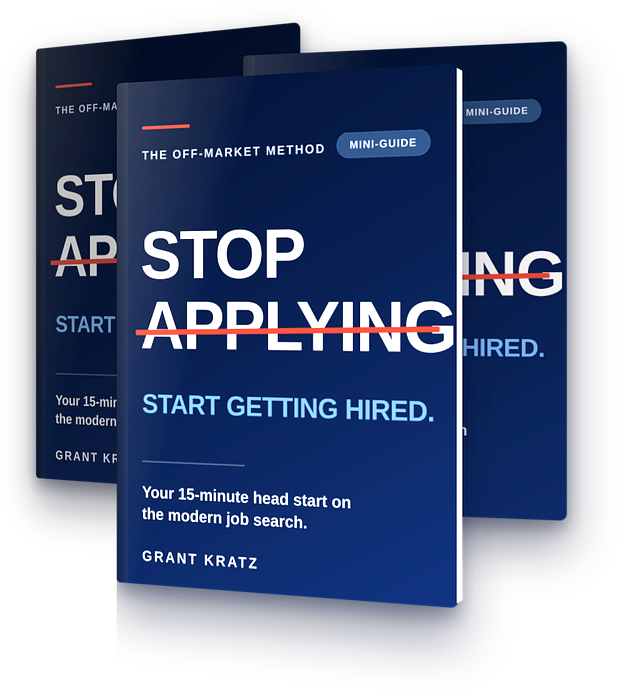 21 pages, a 15-minute read