A resume and a LinkedIn profile should carry the same facts and the same roles, so they never disagree. What changes is the part that does a different job on LinkedIn: a headline written for search, an About in your own voice, and skills your resume backs up. A resume is skimmed for a shortlist. A profile is where people land when they look you up.
Your resume and your LinkedIn profile describe one career, and anyone who reads both should meet the same person. That matters most when somebody looks you up: the recruiter a former colleague passed your name to, or the hiring manager you messaged yesterday. If the two disagree, or the profile gives them nothing to go on, the conversation can cool before it starts. The answer isn't writing your career twice. It's knowing which parts carry across as they are, and which have a different job to do.
What is the difference between a LinkedIn profile and a resume?
The facts are the same. The reader and the moment are not. A resume arrives with an application or a referral, and it's read by someone deciding whether to shortlist you for one role. That reader moves fast: Ladders' eye-tracking study found recruiters spend an average of 7.4 seconds on a first pass of a resume.
A profile is where people land when they look you up, often after a referral or a message, and they're deciding something else: whether you're worth a reply or a call. It also carries what a resume leaves out, like a photo, recommendations and your posts. LinkedIn's own figures show members with a profile photo get 21 times more profile views and 9 times more connection requests than those without one. And recruiters find profiles by searching, so the words at the top of yours decide whether you turn up at all.
Should your LinkedIn experience match your resume?
Yes. Titles, employers, dates and numbers must be identical, because a recruiter with both open will notice any difference. The words can match too: your roles can go across as they stand, since the resume is where each line was already chosen, cut and checked. Rewording them isn't an improvement. It's a chance to lose a figure you fought for, and to end up with two documents that disagree about the same job.
Someone who scrolls down to your Experience has already decided to read the detail, so give them the same detail your resume gives. A role that ends in March on one and April on the other rarely sinks anything on its own, but it plants a doubt just as someone was deciding whether to trust the rest. Trim a line on the profile if it reads long, but never change a fact.
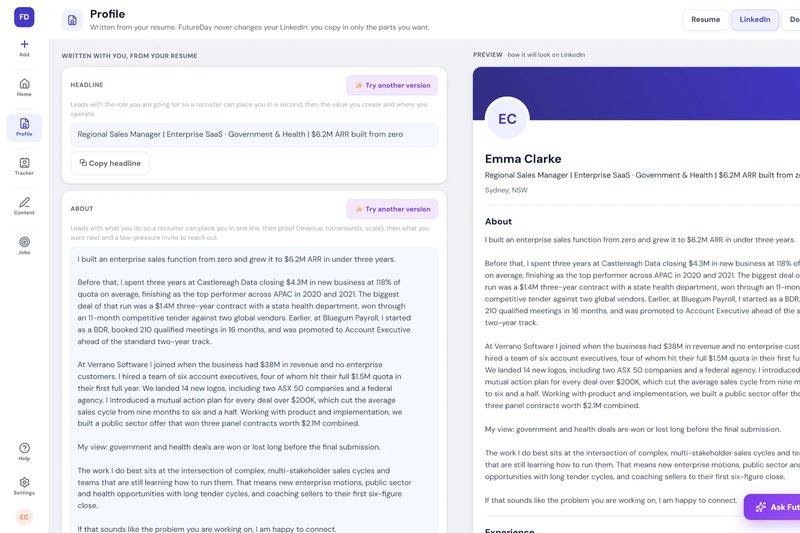
FutureDay's LinkedIn Optimiser works this way. It carries your roles across from your finished resume word for word and writes the headline, About and skills from it. You paste each section into LinkedIn yourself.
How is a LinkedIn headline different from a resume headline?
A resume headline sits under your name and tells a reader what they're holding. A LinkedIn headline has to get you found. It shows under your name in search results, comments and messages, and recruiters search by job title. So lead with the role you want next, then the industry or function that narrows it, then one claim carrying one figure at most. Aim for 100 to 140 characters of LinkedIn's 220: written to the limit, a headline reads as a keyword list, and phones cut the end anyway. Leave out any count of years.
Job titles need one extra step. If your employer called you something nobody outside the company would search for, keep that title as held in your Experience, where it has to match your resume and your references. Put the name the market uses in your headline and skills, where search reads it.
Before (the internal title): "Director, Fulfilment Excellence"
After (written for search): "Head of Supply Chain | Retail and E-commerce | Cut distribution costs 22% across three fulfilment centres"
How is a LinkedIn About section different from a resume summary?
A resume summary makes your case in short paragraphs of direct statements, with the subject left out. An About is you talking: first person from the first word, and never your own name, because LinkedIn prints it just above.
It also gets more room, 1,500 to 2,200 characters of LinkedIn's 2,600, and a different order. Open with who you are and your clearest claim of value, since only the first two or three lines show before "see more". Then the career arc behind it, what you've achieved and at what level, and your operating belief: how you get results, not just that you do, in a sentence or two of your own words. Close with what you want next and an easy invitation to get in touch. If you're still employed and looking quietly, name the work you want more of rather than the move.
Before (a resume summary, pasted in): "Supply chain executive leading fulfilment and distribution across retail and e-commerce. Redesigned a three-centre network, cutting distribution costs 22%."
After (the opening of an About): "I rebuild fulfilment networks that have outgrown their systems. Most recently that meant three centres and a 22% cut in distribution costs. I start on the warehouse floor rather than in the spreadsheet, because the people doing the work already know where it breaks."
The first is a good resume summary. On a profile it reads like a file about someone else; the second is the same facts in your own voice.
Which skills should you list on LinkedIn?
Up to 25, and only ones your resume backs up. A skill on a profile is a claim, and a recruiter may open the conversation with it, so each one should be something you can talk about with an example. Order matters more than length. The first few are what LinkedIn shows before "Show all", so make them the title you're aiming for, your core skill and your main tool or method. Then your technical skills, then a few soft ones, in the words job descriptions in your field use.
Is it your resume or your LinkedIn profile that isn't working?
Two kinds of silence point at different fixes. Hearing nothing after you apply can mean the resume, the tailoring or the fit, but just as often it's the route: an advertised job draws a crowd, and a strong resume can sit in that pile unread. The resume is the quickest of those to rule out.
The other silence is nobody coming to you: no recruiter messages, and no replies to the messages you send. That points at the top of your profile. If the headline and skills don't match how people search, you're not being found. If the About doesn't place you in its first lines, you're found but not believed. Most people only work on the resume, because it's the document they send, and assume the profile is fine because nobody complains about it.
Where FutureDay fits
This is how FutureDay's LinkedIn Optimiser works: it copies your roles from your resume word for word, then writes your headline, About and skills fresh for the people who look you up.
Each of the resume examples by job shows the two side by side: the resume's headline, and the LinkedIn headline that goes with it.
Your resume and profile carry the same facts, and your roles can go across word for word.
A resume is skimmed for a shortlist; a profile is where people land when they look you up.
Write the headline for search: the role you want, your field and one claim, in 100 to 140 characters, with no count of years.
Write the About in the first person, clearest claim first, and list up to 25 skills your resume backs.
Silence after applying can be the resume or the route; nobody reaching out points at the top of your profile.